
Madrid-Barajas Adolfo Suárez Airport (MAD)
Located 12 km northeast of central Madrid, Barajas is Spain's busiest airport and one of Europe's major intercontinental hubs. The airport covers approximately 3,050 hectares and operates four runways arranged in two parallel pairs.
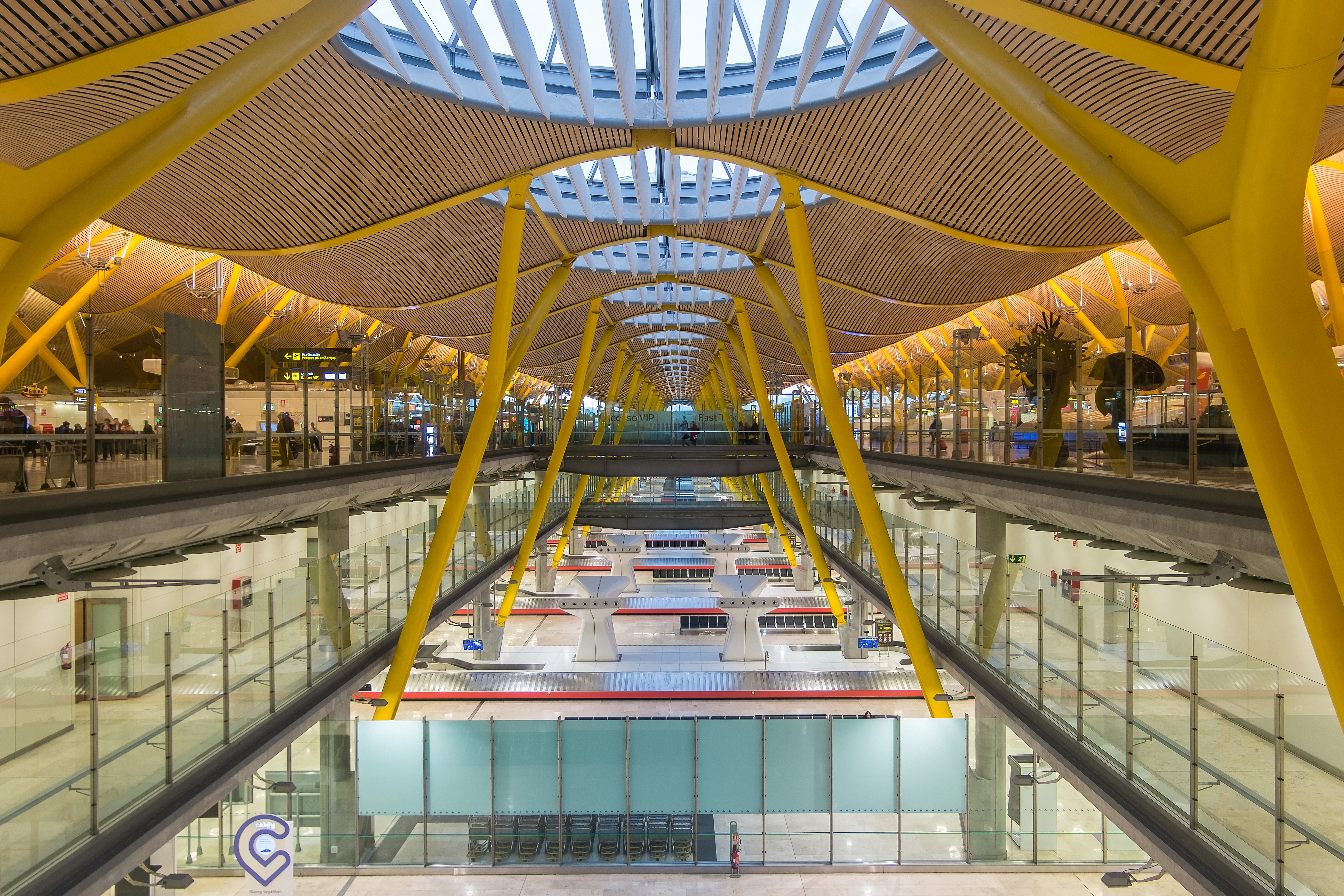
Barajas has five terminals in operation. T1, T2, and T3 handle primarily European and domestic services under the Schengen framework. T4, opened in 2006 and designed by architect Richard Rogers, serves Iberia's intercontinental routes and SkyTeam-aligned carriers. T4S (Satellite) is connected to T4 via an underground automated train.
The airport was officially renamed Adolfo Suárez Madrid-Barajas Airport in 2014 to honour Spain's first democratically elected prime minister after the Franco era.
Terminal Layout
| Terminal | Primary Use | Notable Airlines |
|---|---|---|
| T1 | International (non-Schengen, Star Alliance) | Lufthansa, United, Air Canada |
| T2 | European Schengen routes | Various European carriers |
| T3 | Domestic and short-haul | Air Europa |
| T4 | Iberia hub, intercontinental | Iberia, British Airways |
| T4S | T4 satellite gates, long-haul | Connected via subway to T4 |
Ground Transport from Madrid Barajas
The Madrid Metro Line 8 (Aeropuerto) runs direct services from T2 and T4 to Nuevos Ministerios and Atocha stations in central Madrid. Journey times are approximately 25 minutes. A supplement fare applies for airport travel on top of the standard Metro zone pricing.
The Cercanías C-1 suburban rail line serves T4 with stops at Atocha and Chamartín railway stations, offering a cost-effective alternative without the airport supplement. Express coaches (Exprés Aeropuerto) run 24 hours a day connecting all terminals with Atocha, Cibeles, and the city centre.
Barcelona-El Prat Airport (BCN)
Spain's second-busiest airport serves Barcelona from a coastal site 14 km southwest of the city centre in El Prat de Llobregat. The airport operates two main terminals: the older T2 (formerly used by Spanair and low-cost carriers) and the modern T1, which opened in 2009 and consolidated the majority of operations.
T1 is designed for approximately 55 million passengers per year and contains separate departure and arrival flows across multiple floors. The terminal is served by a free internal shuttle bus connecting it with T2.
Ground Transport from Barcelona-El Prat
The Aerobus express coach services run separately for T1 (A1) and T2 (A2), connecting both terminals with Plaça Espanya, Gran Via, and Plaça Catalunya in central Barcelona. Journey times range from 25 to 35 minutes depending on traffic.
The R2 Nord Cercanías (Rodalies) suburban rail line connects T2 with Barcelona Sants, Passeig de Gràcia, and Clot stations in approximately 20 minutes. Note that T1 is not served directly by rail; passengers must take the shuttle bus to T2 to access the train.
The Catalan and Spanish governments have discussed multiple proposals to expand Barcelona-El Prat's capacity. Negotiations over the expansion's footprint, particularly its potential encroachment on the protected Llobregat Delta natural area, have prevented a final agreement as of mid-2024.

Málaga-Costa del Sol Airport (AGP)
Málaga Airport is the main gateway for the Costa del Sol and the broader Andalusia region. Located 8 km southwest of Málaga city centre, it consistently ranks among Spain's top three airports by passenger volume during summer months due to heavy charter and low-cost carrier traffic from northern Europe.
The airport has two terminals, T2 and T3, which are physically connected and operate as a single passenger zone. A new Terminal 3 expansion completed in 2010 more than doubled the facility's capacity.
Ground Transport from Málaga Airport
The C-1 Cercanías line provides direct rail access between the airport's underground station and Málaga city centre (María Zambrano and Centro-Alameda stations). The service runs every 20 minutes and takes approximately 12 minutes to María Zambrano, where AVE high-speed rail connections to Madrid and other cities are available.
Regular bus services connect the airport with the coastal resort town of Torremolinos, Benalmádena, Fuengirola, and Marbella. Taxis operate from a dedicated rank outside arrivals.
Palma de Mallorca Airport (PMI)
The Balearic Islands' main airport, located 8 km east of Palma city, handles substantial summer traffic concentrated between May and October. It has two terminals (T1 and T2) and consistently processes among the highest passenger volumes in Spain during peak summer months.
Ground transport options include the EMT city bus (line 1) connecting the airport with the city centre, taxis, and rental car facilities. There is no direct rail connection to Palma city centre from the airport.
Alicante-Elche Miguel Hernández Airport (ALC)
The main air gateway for the Costa Blanca and Murcia regions operates from a single terminal building opened in 2011, replacing the original facility. The airport serves primarily charter and low-cost European carriers with high seasonal concentration.
C-6 Cercanías services connect the airport with Alicante city centre (approximately 25 minutes) and Elche. Bus lines also operate to Alicante and the main coastal resorts of the Costa Blanca.
Practical Notes for All Airports
- All Spanish airports require government-issued photo ID for domestic flights within the EU. A passport or national ID card is accepted.
- Security wait times at Madrid Barajas and Barcelona El Prat during peak summer morning departures (06:00–10:00) can exceed 45 minutes at T1/T4. Arrivals at least 90 minutes before domestic departures and 2 hours before international are generally sufficient outside peak periods.
- Car rental facilities at Spanish airports are generally located either in the terminal building or a short shuttle ride away in an off-site compound.
- All AENA airports have free WiFi. The AENA mobile app provides real-time flight status and terminal maps for all 46 airports.